What was the Mayfly CTV ad fraud scheme?
Mayfly is Pixalate's name for an apparent connected TV ad fraud scheme in which bid requests claimed to reach streaming audiences on TVs that appeared to exist only in the ad traffic. Pixalate called them “burner TVs” because their advertising IDs turned over from one day to the next. It counted 3,277 impersonated app IDs across six platforms and estimated about $135 million in advertiser spend at risk from May through October 2026. That figure is a projection from sampled traffic at an assumed $25 per thousand impressions. Pixalate's Mayfly investigation and estimate
How could a burner TV generate ad revenue?
The bid request offered an advertiser a chance to reach someone watching an app such as Plex, Hulu, The Roku Channel or Tubi. Pixalate identified those apps as impersonated inventory. If a buyer won the auction and the exchange accepted the reported impression as billable, the selling account could earn a share of the charge. Pixalate did not identify a specific payout or report that the scheme manipulated campaign pacing.
Why compare sellers for the same streaming app?
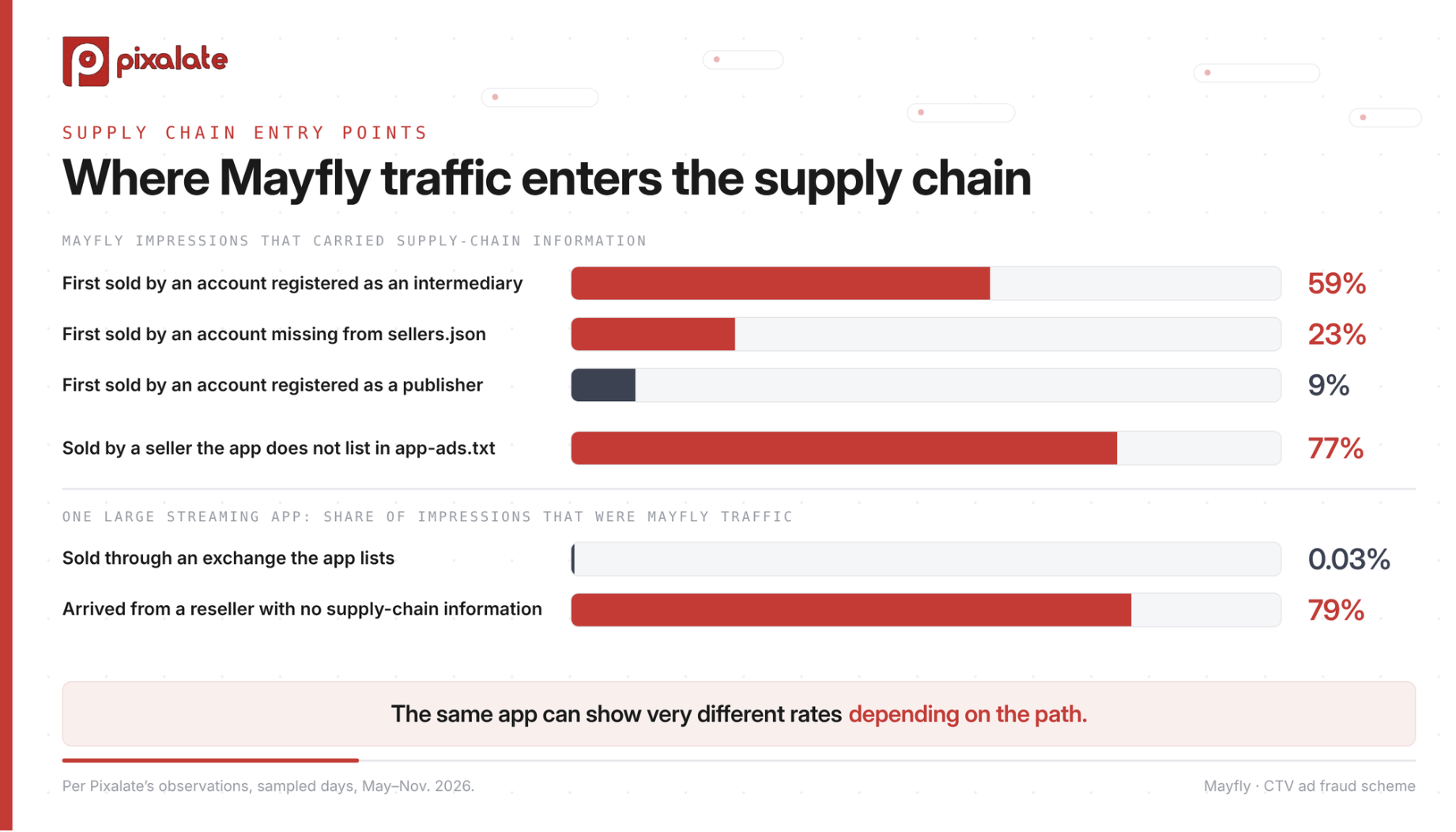
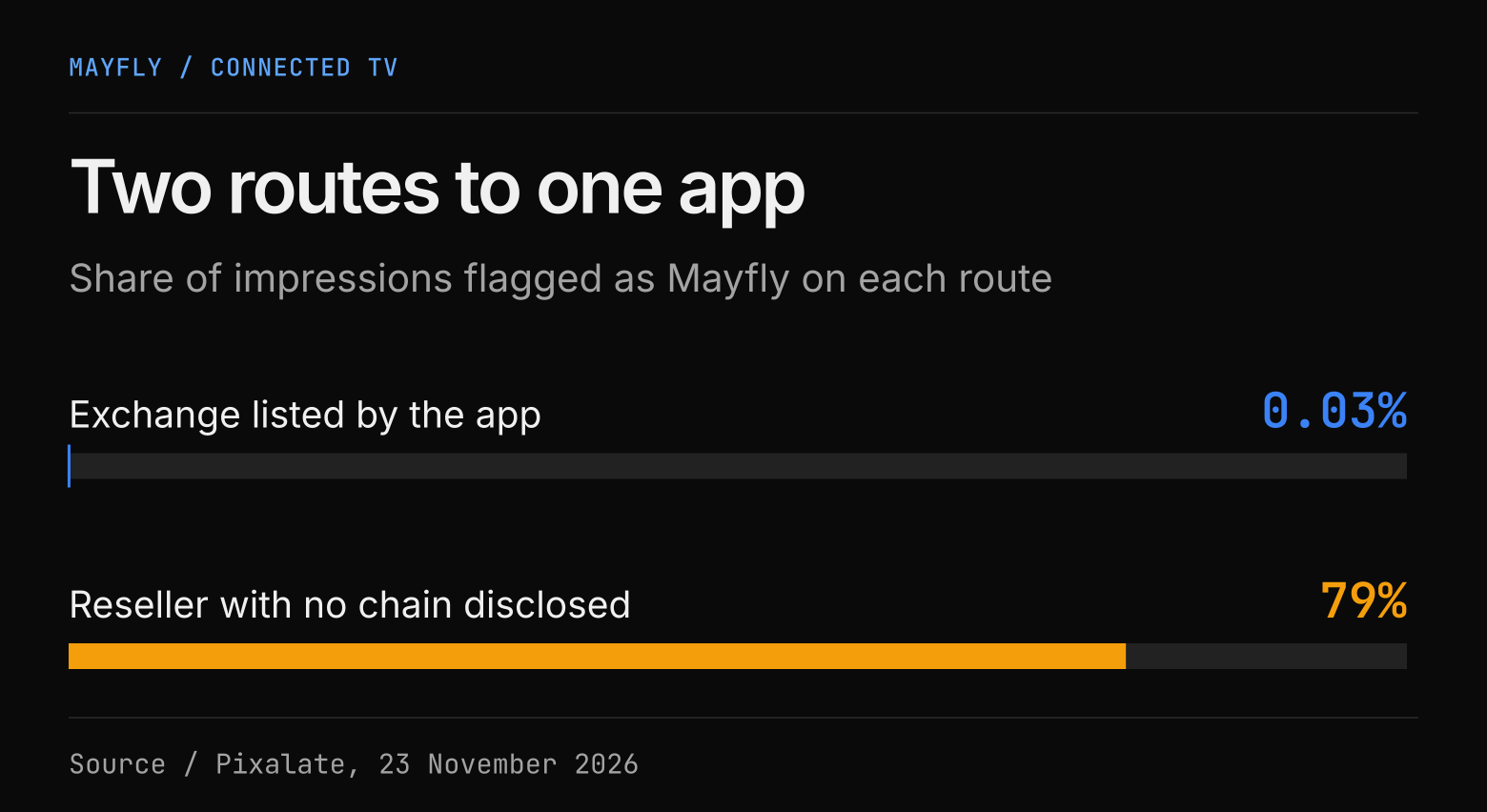
On one route to an unnamed streaming app, Pixalate flagged 0.03% of impressions as Mayfly. On another route to the same app, it flagged 79%. A buyer looking only at the app name would have filed both purchases under the same line. The first thing I'd change in that report is its grouping key.
The first figure came from an exchange the app listed. The second came from a reseller route that supplied no selling-chain information. Each percentage uses that route's own impressions as its denominator. Pixalate did not disclose the traffic volume on either route. You can use the comparison to decide where to investigate. You cannot calculate the dollars on either path from those two percentages alone. Pixalate's route comparison
Preserve the seller account when you ingest the request
Start the report with the claimed app identifier and TV platform, the exchange connection on which the request arrived, and the selling account for that connection where it is known. Keep the declared SupplyChain nodes alongside those fields. A seller ID has meaning inside an advertising system. Joining two exchanges on the string 1234 can turn unrelated businesses into one seller.
The distinction between observed and declared fields matters later. A buyer can usually tell which exchange connection carried a request. On that connection, the chain describes what the sender says happened upstream. If the sender omits it, retain an explicit missing-chain bucket. Filling in the publisher's usual path would silently turn the least documented purchases into apparently normal ones.
Give the validator a question it can answer
Here is a small local control for the ingestion step. It uses RTBlint's Node package and synthetic banner inventory to keep the test focused on a single JSON field. This is a parser test, separate from the CTV investigation.
import { validate } from "rtblint-core";

for (const complete of ["1", 1]) {
  const request = {
    id: "test",
    imp: [{ id: "1", banner: { w: 300, h: 250 } }],
    source: { schain: {
      ver: "1.0", complete,
      nodes: [{ asi: "exchange.example", sid: "17", hp: 1 }]
    } }
  };
  const result = validate(JSON.stringify(request), "2.6-202606");
  console.log(typeof complete, result.valid, result.issues.map(issue => issue.path));
}
The string produces false and a finding at source.schain.complete. The integer produces true and no findings with that snapshot. If a pipeline converts everything to strings before validation, the test catches the damage. With SupplyChain 1.0, the integer 1 is the sender's declaration that the chain is complete. Passing the test tells you the declaration is well formed. A seller can still make a structurally valid claim about an app it has no right to sell. RTBlint's validator and example
Check the account as it stood on the day of the bid
For the route under review, locate the publisher's app-ads.txt through its app-store developer listing. Look up the advertising-system domain and seller account together. Check the relevant exchange's sellers.json for the account, then compare the relevant declarations with the route the buyer actually observed. Preserve the files and fetch times used for the review. A file downloaded today cannot by itself establish what it listed last month. IAB Tech Lab on app-ads.txt · sellers.json and SupplyChain
Suppose the publisher lists account 17 at Exchange A and the bid arrived through Exchange B with seller ID 17. The matching numbers alone establish nothing. Conversely, an exchange directory can legitimately withhold some descriptive seller details. A present account with limited public information, a missing account, and an unavailable directory deserve different entries in the report.
How do you measure next-day CTV device ID churn?
Start with one app, TV platform and seller route. Among addresses seen on both UTC dates, count the distinct address and advertising-ID pairs on day one. Divide the number of those pairs that recur on day two by the day-one count. Report both counts and compare similar sampling volumes. A missing or privacy-limited device.ifa supplies no usable device ID for this comparison.
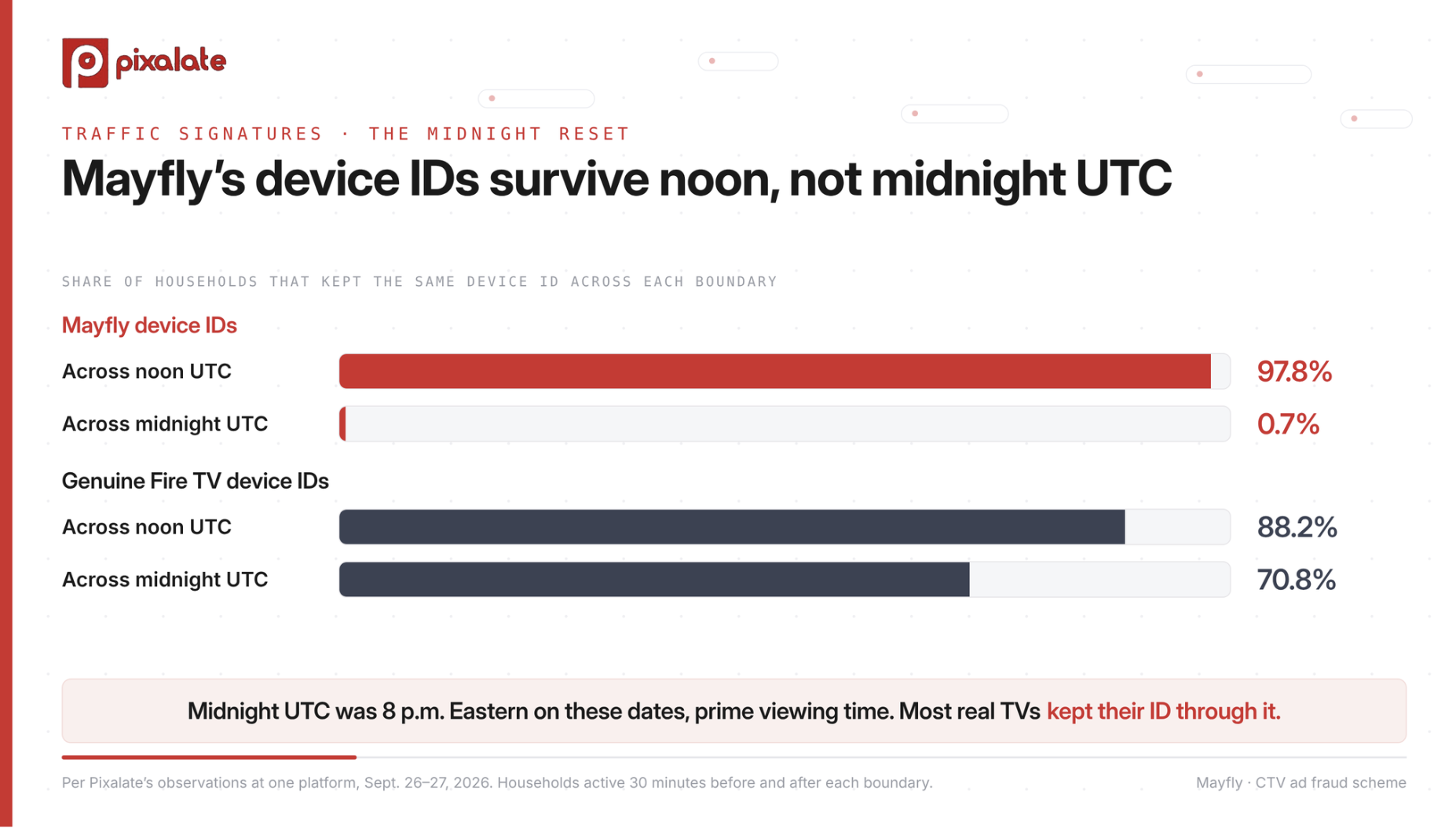
Pixalate reported a 0% next-day return rate for device IDs in flagged traffic. It used turnover to select suspicious addresses, which makes a low rate a lead to investigate. A separate test found that 0.7% of flagged households retained an ID across midnight UTC on one platform. That percentage counts households in a short window, so it answers a different question. Pixalate's midnight comparison
Make the alert small enough to investigate
I'd attach the route, dates, eligible pair count, returning pair count and sampling coverage to an alert. Compare the route with its own recent history and another path to the same app and platform. An exchange that starts sampling one request in ten will make genuine devices harder to observe twice. A route-level notification gives the integration team somewhere specific to check before anybody changes a bid rule.
If the publisher disavows the selling account for the period, pause that app on that route and reconcile the affected charges. If the buyer has a missing chain and unreliable logs, label the exposure unresolved. A campaign can keep buying through independently verified sellers while the disputed account is reviewed.
If the seller disputes a charge, ask for the saved creative and the playback records for that transaction. Check the VAST response for duplicate impression URLs, then compare the impression beacon with an independent player event.
The executable SQLite example on DEV shows exactly which devices enter the denominator. The companion billing example carries the same route into the invoice. My longer Medium piece covers the named streaming services and how Pixalate estimated the financial exposure. Returning TV IDs on DEV · Reconciling the bill on DEV · The Mayfly case on Medium